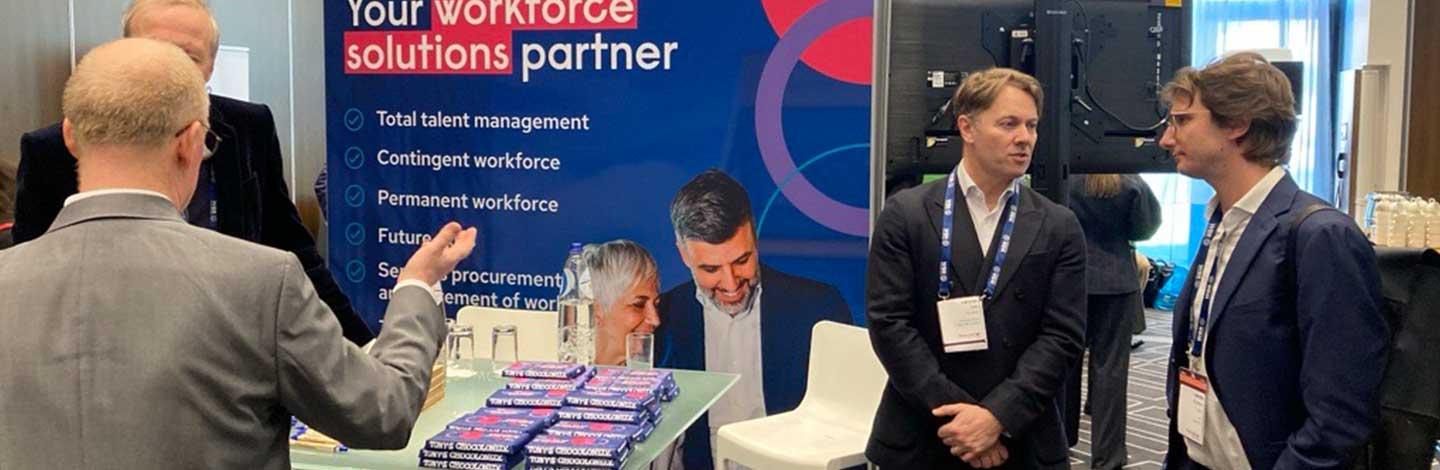

After spending two days at ProcureCon Total Talent in Amsterdam, with fellow team members, one thing is clear: the world of workforce strategy is developing faster than ever, and organisations are seeking to connect the dots between people, technology and business outcomes. For those who couldn’t be there, here is my take on the themes that stood out strongly in discussions and content.
HR and procurement must collaborate to unlock true total talent management
Total talent is still an aspirational goal; there is a shift to it becoming a tangible solution. Speakers across the course of the event agreed unanimously, that meaningful workforce intelligence is challenging without HR and procurement working in partnership. Organisations need clear visibility of 'who’ is doing the work across the entire business. Those who are succeeding with total talent management have one thing in common – robust management information that brings together permanent, contingent and services spend in a single view. So, how do you get there? The discussions made it clear that the foundations must include:
Clear programme ownership
Shared workforce priorities
Aligned governance structures
A standardised hiring taxonomy of language across all types of worker
These points came through strongly in Evan Sutherland, CPO at Balfour Beatty’s presentation, where he outlines how they have built workforce readiness through forecasting, platforms and supplier partnerships.
My key takeaway was, that organisations which keep procurement and HR functions in silos will struggle to make clear decisions based on a full, joined up picture of their entire workforce.
Orchestration and triage tools are gaining real momentum
The standout keynote for me was ‘Fix the front door: how do you build clear intake pathways to achieve alignment and enable smarter talent procurement decisions’ which highlighted how you clarify external and permanent workforce ownership to achieve consistency across HR, procurement and operations. The panel (Michelle Gates, Director, EMEA Talent Tech & Operations, Netflix, Marcela Balan, Global Senior Category Manager, Haleon, Magosia Grochowska, Global Category Manager, Cargill, and Deborah Bode-Harrison, Global Category Manager, Anglo American) shone a light on orchestration and triage. We now have technology capable of streamlining how workforce requirements enter an organisation, whether the need is for permanent talent, contingent workers or statement‑of‑work support. As providers, we have a responsibility to go further. We should be helping HR and procurement challenge the status quo and empowering hiring managers to rethink long‑standing, legacy processes that no longer serve today’s workforce reality.
My key takeaway is that adoption only sticks when the tools are implemented to solve a real business problem, rather than simply introduce another digital layer. Creating a single, intuitive entry point for hiring managers can transform the experience, but only if managers feel the value. The priority shouldn’t be the tool itself, but the clarity and consistency it enables.
AI continues to evolve, should organisations create safe ways to experiment?
There was broad recognition that most organisations are still early in their AI journey, although digital assistants are gaining pace for early adopters. Richard Beaumont, Chair of the event over the two days, highlighted that users of AI tools rate their confidence to adopt AI at 1.5 out of 5. I found this to be an interesting conundrum, when there is so much ‘noise’ around AI adoption.
How can organisations support AI adoption? I think rather than dictating rigid rules about how AI should be used, we need to be thinking whether organisations are creating safe, governed spaces for teams to explore, learn and iterate.
AI governance, risk frameworks and clear guardrails are essential, but progress comes from encouraging experimentation rather than stifling it. My key takeaway on AI from the event is this, as AI becomes more embedded in recruitment, onboarding and workforce planning, we need to create a balance between freedom and responsibility. Is the design of your organisation ready for this change?
Workforce visibility is essential for workforce planning and optimisation
One of the themes that came up consistently at ProcureCon was the importance of seeing your whole workforce clearly. It sounds obvious, but the reality is that most organisations still don’t have a true picture of everyone working for them at any given moment. Permanent employees might sit in the HR system, contingent workers in a vendor management system, statement of work (SoW) consultants in a procurement platform, and freelancers or gig workers somewhere in between, sometimes captured properly, sometimes not. When data is spread out like this, it becomes extremely difficult to answer fundamental questions such as:
How many people are we actually using?
What skills do we have?
Where are the risks?
And what is all of this costing us?
The consensus from the conference was that visibility must go beyond a simple headcount. The organisations that are moving forward fastest are the ones building a joined-up view that includes skills, spend, supplier performance, compliance, and whether the current mix of talent is genuinely meeting business demand.
Without this, functions tend to optimise in isolation. Procurement might squeeze cost out of contingent labour, only for SoW spend to rise somewhere else, because no one is looking at the whole picture.
Importantly, gaining visibility doesn’t mean ripping and replacing every system. It’s more about getting the building blocks right, establishing common definitions, aligning data taxonomies, and agreeing who owns what. Which intersects nicely with the session by Carrie Cottle, Director, Contingent Workforce Programmes, HR, CSL Behring, where she provided a thought-provoking HR perspective on how to centralise talent systems and reduce supplier complexity to achieve efficiency, visibility and standardisation.
What came through strongly is that the benefits are real and immediate: better forecasting, more confident planning, clearer cost management, and far fewer blind spots when it comes to risk.
My takeaway from this was that with a full picture, organisations can also make smarter decisions about whether they need a permanent hire, a contractor, a services partner, or even automation. As one delegate summed it up perfectly: “You can only manage what you can see.”
The hiring manager experience belongs to everyone
Hiring managers were repeatedly referenced as a shared customer group across HR, procurement, finance and talent acquisition. In many organisations, hiring managers are expected to navigate a maze of requirements: adopt new AI-driven tools, hire permanent employees, engage contingent talent, and then switch to an entirely different process for services procurement. And when it comes to SoW engagements, the expectation is often that they can scope, articulate and manage outputs with little guidance. It’s no wonder the experience feels fragmented.
In my view, improving their experience is not a single department’s responsibility, it requires cross-functional ownership between HR, procurement and workforce suppliers.
My key takeaway: When organisations design processes with hiring managers, rather than for them, the benefits cascade into speed, compliance, quality of hire and importantly cost reduction.
And finally… Bots are coming, but who owns them?
One of the more amusing but thought-provoking questions: if HR owns people, procurement owns suppliers, and finance owns funding… who’s responsible for digital workers and AI bots?
It’s a light-hearted reminder that our operating models haven’t fully caught up with the reality of automation.
As digital labour becomes part of the workforce ecosystem, organisations will need clearer accountability frameworks.
At Reed Talent Solutions, we deliver top-tier talent and digital transformation services, strategic procurement, and future-ready skills. Whether you're scaling your workforce, optimising operations, or navigating digital change, we can unlock potential and drive sustainable growth. Talk to Matt, or one of our other experts, to explore how we can help.