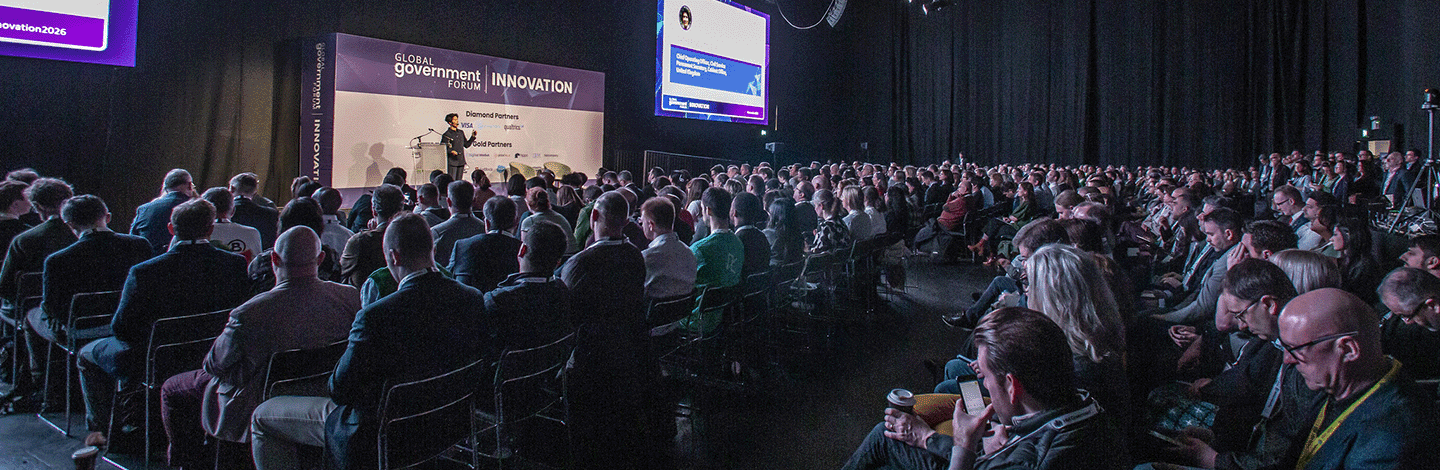
Representing Reed Talent Solutions at the Global Government Forum Innovation 2026 were Louise Reed, Future Skills Director, Tracey Dawes, Client Engagement Director for public sector, and Simon Lomax, Senior Principal Consultant.
While artificial intelligence, quantum computing and digital sovereignty dominated the technical agenda, the strongest and most consistent message was that technology itself is no longer the barrier. The real determinants of progress are capability, culture, and talent, a direction that aligns directly with where Reed Talent Solutions are supporting clients across future skills, digital transformation and workforce solutions.

Innovation shaped by people, not platforms
Louise observed that senior leaders repeatedly emphasised the importance of collaboration, curiosity and confidence in driving meaningful innovation. Cat Little, COO of the UK Civil Service and Permanent Secretary at the Cabinet Office, stressed that innovation must make people’s lives better and highlighted tangible impact already being delivered, such as £0.5bn invested in fraud detection through AI and data. She reinforced that digital identity remains a central priority for government.
Leaders from the Government Digital Service (GDS) echoed this people-centred approach, sharing how their “fast and curious” ethos, backed by increased funding, is enabling faster delivery. However, they were clear that talent remains the critical dependency, as without the right capability, even the most promising technologies cannot scale.
Samantha Jones, Permanent Secretary at the Department of Health and Social Care, emphasised that multi-year budgets are helping to embed long-term transformation, but the greatest challenges that remain are skills, leadership and culture. Her perspective was simple - digital should be everyone’s business, not the responsibility of a single team.
From the Department for Science, Innovation and Technology (DSIT), Emran Mian highlighted that innovation itself is abundant - the challenge is scaling it responsibly. DSIT’s focuses include the use of AI tools in speeding up planning applications to personalised AI-based tutoring capabilities in schools, reflecting a growing focus on practical, value-driven applications of technology.
Technology trends reshaping the next decade
Louise’s insights from day two highlighted the rise of quantum threats and the increasing importance of digital sovereignty, as shared by IBM’s Cristina Caballé Fuguet. With 69% of leaders now actively investing in AI, the conversation is shifting from experimentation to readiness.
Local government leaders reinforced the need for safe environments to prototype and experiment, emphasising that building credibility often starts with demonstrating quick, visible value. AI specialists across councils also advised against overusing the term ‘AI’, suggesting that framing AI tools as enablers of capacity and capability helps bring people on the journey.
Simon built on this theme, noting that many government departments will need to prioritise data cleansing before they can fully adopt AI. Without high quality, interoperable data, the opportunity for AI-powered services is limited. He also highlighted that cyber security remains tightly connected to all data-led initiatives, and that quantum computing, while not yet fully understood, will become increasingly important.
He observed a clear trend across UK government - a drive to bolster internal advisory and delivery capability across AI, data and other emerging technology domains. This shift reflects the growing need for sustainable, long-term expertise rather than purely external, project-based interventions.
A mindset of curiosity and experimentation
Tracey’s key takeaway centred on mindset. For her, the event reinforced that government leaders are being encouraged to take more calculated risks, to invest in people and to stay curious. The strongest examples of transformation came from teams who had created space to explore new approaches, test ideas early and learn quickly. Her reflection echoed a recurring theme across the event - innovation is not just about adopting new technology, it is about creating the conditions for people to experiment confidently.
What this means for organisations
Across the two-day event, three clear themes emerged:
Future skills: There is an urgent need for digital, data and AI capability building, leadership development and structured reskilling pathways.
Digital transformation and change: Support is required around cultural change, AI-readiness, service redesign and the adoption of responsible innovation practices.
Workforce solutions: There is growing demand for flexible talent models, digital, data and technology (DDaT) pipelines and managed services that can support long-term delivery.
For the team, Global Government Forum Innovation 2026 reinforced the scale of change facing government. The event highlighted that partnerships will underpin sustainable innovation, and that the next decade of transformation will be shaped by people.
There is strong alignment between government priorities and Reed Talent Solutions’ capabilities. Get in touch with the team to explore how we can help.